Linear Equations In Two Variables
Linear Equations in Two Variables

A linear equation in two variables is an equation in which two variables have the exponent 1. A system of equations with two variables has a unique solution, no solutions, or infinitely many solutions. A linear system of equations may have 'n' number of variables. An important thing to keep in mind while solving linear equations with n number of variables is that there must be n equations to solve and determine the value of variables.
Linear equations in two variables are the algebraic equations which are of the form (or can be converted to the form) y = mx + b, where m is the slope and b is the y-intercept. They are the equations of the first order. For example, y = 2x + 3 and 2y = 4x + 9 are two-variable linear equations.
What are Linear Equations in Two Variables?
The linear equations in two variables are the equations in which each of the two variables is of the highest order (exponent) of 1 and may have one, none, or infinitely many solutions. The standard form of a two-variable linear equation is ax + by + c = 0 where x and y are the two variables. The solutions can also be written in ordered pairs like (x, y). The graphical representation of the pairs of linear equations in two variables includes two straight lines which could be:
Forms of Linear Equations in Two Variables
A linear equation in two variables can be in different forms like standard form, intercept form and point-slope form. For example, the same equation 2x + 3y=9 can be represented in each of the forms like 2x + 3y - 9=0 (standard form), y = (-2/3)x + 3 (slope-intercept form), and y - 5/3 = -2/3(x + (-2)) (point-slope form). Look at the image given below showing all these three forms of representing linear equations in two variables with examples.

The system of equations means the collection of equations and they are also referred to as simultaneous linear equations. We will learn how to solve pair of linear equations in two variables using different methods.
Solving Pairs of Linear Equations in Two Variables
There are five methods to solve pairs of linear equations in two variables as shown below:
- Graphical Method
- Substitution Method
- Cross Multiplication Method
- Elimination Method
- Determinant Method
Graphical Method for Solving Linear Equations in Two Variables
The steps to solve linear equations in two variables graphically are given below:
- Step 1: To solve a system of two equations in two variables graphically, we graph each equation. To know how, click here or follow steps 2 and 3 below.
- Step 2: To graph an equation manually, first convert it to the form y = mx+b by solving the equation for y.
- Step 3: Start putting the values of x as 0, 1, 2, and so on and find the corresponding values of y, or vice-versa.
- Step 4: Identify the point where both lines meet.
- Step 5: The point of intersection is the solution of the given system.
Example: Find the solution of the following system of equations graphically.
-x+2y-3 =0
3x+4y-11=0
Solution: We will graph them and see whether they intersect at a point. As you can see below, both lines meet at (1, 2). Thus, the solution of the given system of linear equations is x=1 and y=2.
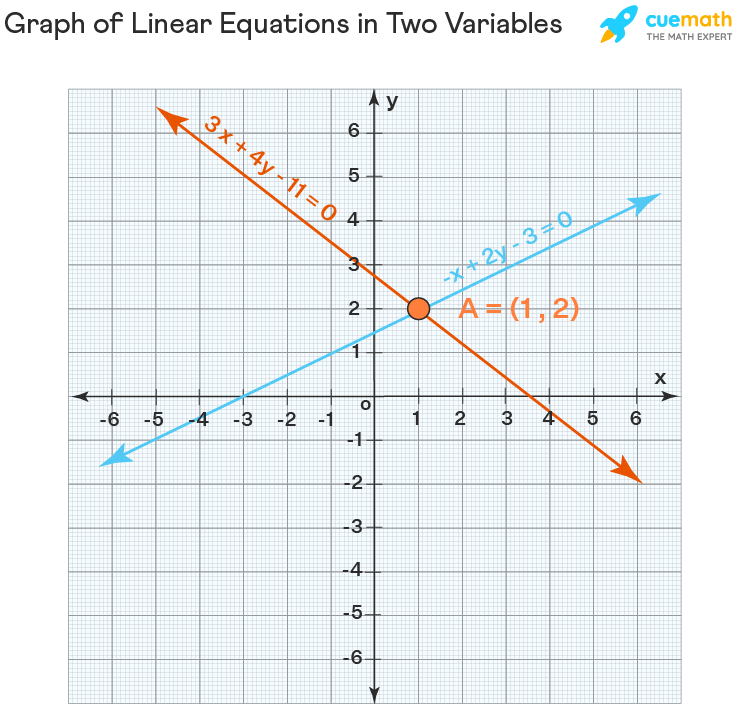
But both lines may not intersect always. Sometimes they may be parallel. In that case, the pairs of linear equations in two variables have no solution. In some other cases, both lines coincide with each other. In that case, each point on that line is a solution of the given system and hence the given system has an infinite number of solutions.
Consistent and Inconsistent System of Linear Equations:
- If the system has a solution, then it is said to be consistent;
- otherwise, it is said to be inconsistent.
Independent and Dependent System of Linear Equations:
- If the system has a unique solution, then it is independent.
- If it has an infinite number of solutions, then it is dependent. It means that one variable depends on the other.
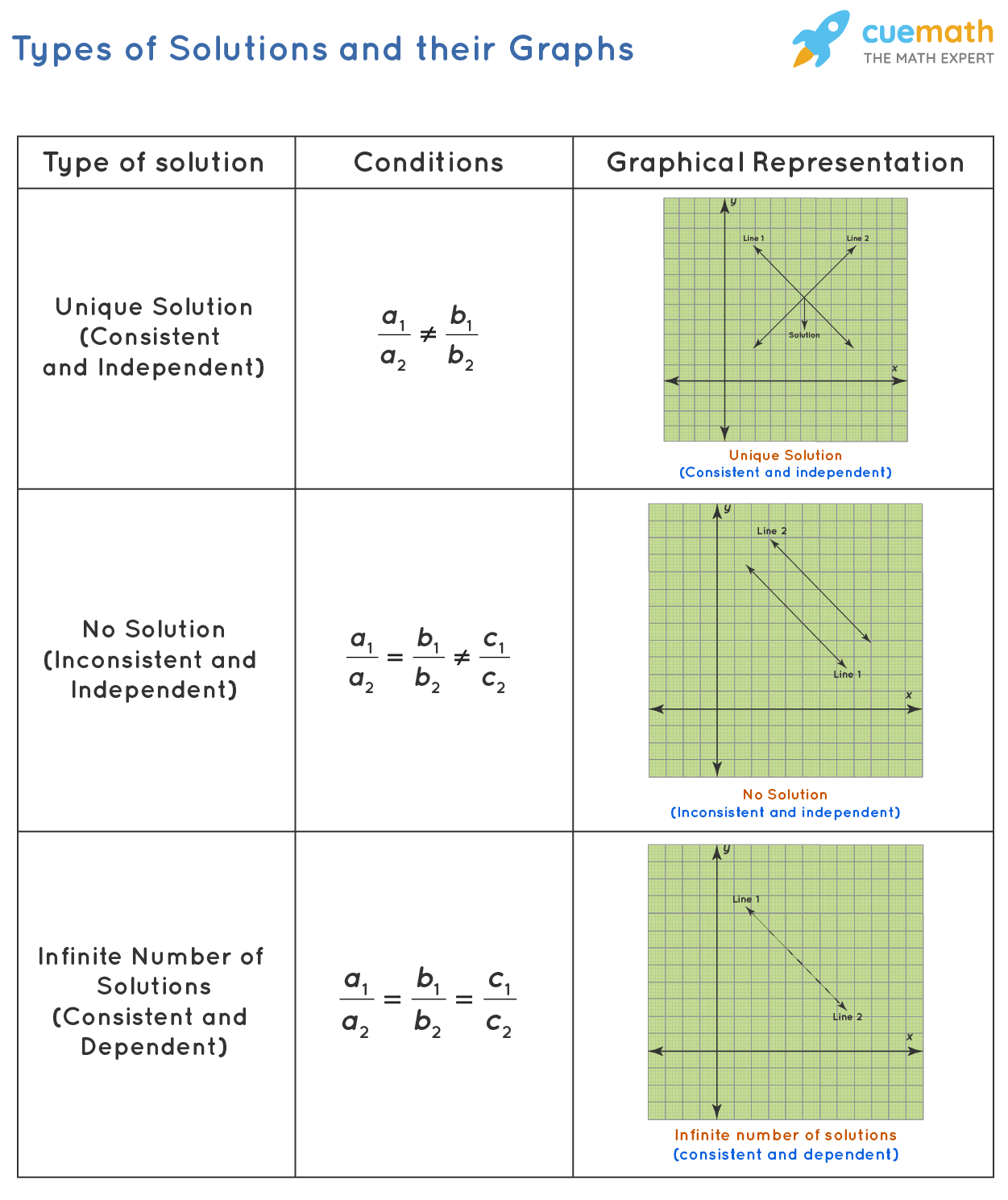
Consider a system of two linear equations: a1x + b1y + c1 = 0 and a2x + b2y + c2 = 0. Here we can understand when a linear system with two variables is consistent/inconsistent and independent/dependent.
Method of Substitution
To solve a system of two linear equations in two variables using the substitution method, we have to use the steps given below:
- Step 1: Solve one of the equations for one variable.
- Step 2: Substitute this in the other equation to get an equation in terms of a single variable.
- Step 3: Solve it for the variable.
- Step 4: Substitute it in any of the equations to get the value of another variable.
Example: Solve the following system of equations using the substitution method.
x+2y-7=0
2x-5y+13=0
Solution: Let us solve the equation, x+2y-7=0 for y:
x+2y-7=0
⇒2y=7-x
⇒ y=(7-x)/2
Substitute this in the equation, 2x-5y+13=0:
2x-5y+13=0
⇒ 2x-5((7-x)/2)+13=0
⇒ 2x-(35/2)+(5x/2)+13=0
⇒ 2x + (5x/2) = 35/2 - 13
⇒ 9x/2 = 9/2
⇒ x=1
Substitute x=1 this in the equation y=(7-x)/2:
y=(7-1)/2 = 3
Therefore, the solution of the given system is x=1 and y=3.
Cross Multiplication Method
Consider a system of linear equations: a1x + b1y + c1 = 0 and a2x + b2y + c2 = 0.
To solve this using the cross multiplication method, we first write the coefficients of each of x and y and constants as follows:

Here, the arrows indicate that those coefficients have to be multiplied. Now we write the following equation by cross-multiplying and subtracting the products.
From this equation, we get two equations:
Solving each of these for x and y, the solution of the given system is:
Method of Elimination
To solve a system of linear equations in two variables using the elimination method, we will use the steps given below:
- Step 1: Arrange the equations in the standard form: ax+by+c=0 or ax+by=c.
- Step 2: Check if adding or subtracting the equations would result in the cancellation of a variable.
- Step 3: If not, multiply one or both equations by either the coefficient of x or y such that their addition or subtraction would result in the cancellation of any one of the variables.
- Step 4: Solve the resulting single variable equation.
- Step 5: Substitute it in any of the given equations to get the value of another variable.
Example: Solve the following system of equations using the elimination method.
2x+3y-11=0
3x+2y-9=0
Adding or subtracting these two equations would not result in the cancellation of any variable. Let us aim at the cancellation of x. The coefficients of x in both equations are 2 and 3. Their LCM is 6. We will make the coefficients of x in both equations 6 and -6 such that the x terms get canceled when we add the equations.
3 × (2x+3y-11=0)
⇒ 6x+9y-33=0
-2 × (3x+2y-9=0)
⇒ -6x-4y+18=0
Now we will add these two equations:
6x+9y-33=0
-6x-4y+18=0
On adding both the above equations we get,
⇒ 5y-15=0
⇒ 5y=15
⇒ y=3
Substitute this in one of the given two equations and solve the resultant variable for x.
2x+3y-11=0
⇒ 2x+3(3)-11=0
⇒ 2x+9-11=0
⇒ 2x=2
⇒ x=1
Therefore, the solution of the given system of equations is x=1 and y=3.
Determinant Method
The determinant of a 2 × 2 matrix is obtained by cross-multiplying elements starting from the top left corner and subtracting the products.

Consider a system of linear equations in two variables: a1x + b1y = c1 and a2x + b2y = c2. To solve them using the determinants method (which is also known as Crammer's Rule), follow the steps given below:
- Step 1: We first find the determinant formed by the coefficients of x and y and label it Δ.
Δ = - Step 2: Then we find the determinant Δx which is obtained by replacing the first column of Δ with constants.
Δx = - Step 3: We then find the determinant Δy which is obtained by replacing the second column of Δ with constants.
Δy =
Now, the solution of the given system of linear equations is obtained by the formulas:
- x = Δx / Δ
- y = Δy / Δ
Important Points on Linear Equations with Two Variables:
- A linear equation in two variables is of the form ax + by + c = 0, where x and y are variables; and a, b, and c are real numbers.
- A pair of linear equations are of the form a1x + b1y + c1 = 0 and a2x + b2y + c2 = 0 and its solution is a pair of values (x, y) that satisfy both equations.
- To solve linear equations in two variables, we must have at least two equations.
- A linear equation in two variables has infinitely many solutions.
Tricks and Tips:
While solving the equations using either the substitution method or the elimination method:
- If we get an equation that is true (i.e., something like 0 = 0, -1 = -1, etc), then it means that the system has an infinite number of solutions.
- If we get an equation that is false (i.e., something like 0 = 2, 3 = -1, etc), then it means that the system has no solution.
Nature of Solution of Linear Equations in Two Variables
A system of linear equations in two variables can have one solution or no solution or infinitely many solutions.
A system of linear equations is consistent if it has a solution, meaning that there is at least one set of values that satisfies all the equations. On the other hand, an inconsistent system does not have a solution, indicating that no set of values can satisfy all the equations simultaneously.
Similarly, a system of linear equations is considered independent if it has a unique solution, meaning that the values of the variables can be determined uniquely. In contrast, a dependent system has an infinite number of solutions.
Unique Solution of Linear Equations in Two Variables
A system of linear equations in two variables has a unique solution if and only if the equations represent two non-parallel lines that intersect at exactly one point. In other words, the lines must have different slopes, indicating that they are not parallel, and they must intersect at one point only.
Therefore, if and are the slopes of the equations of the two lines, then should not be equal to in order for the equations to have a unique solution, that is, .
The unique solution can be found by solving the equations simultaneously using various methods, including substitution, elimination, or matrices. It is important to note that a system of linear equations may have zero solutions or infinitely many solutions if the lines are parallel or coincide with each other.
No Solution of Linear Equations in Two Variables
A system of linear equations in two variables has no solution if and only if the equations represent two parallel lines that do not intersect. In other words, the lines must have the same slope, indicating that they are parallel, and they do not intersect.
This can be represented mathematically as , where m_1 and m_2 are the slopes of the lines.
When a system of linear equations has no solution, it means that there is no value for each variable that satisfies both equations simultaneously. This situation is often called an inconsistent system, and it arises when the lines represented by the equations do not cross each other.
Infinite Solutions of Linear Equations in Two Variables
It is important to note that a system of linear equations may have infinitely many solutions if the equations represent the same line or coincident lines. In such a case on of the linear equation is a scalar multiple of the other equation, like in the case of x + y =2 and 2x + 2y = 4.
How to Solve Linear Equations in Two Variables
The various methods to solve linear equations in two variables are given below:
- Substitution Method
- Elimination Method
- Cross-multiplication method
- Graphical Method
- Determinant Method
Substitution Method to Solve Linear Equations in Two Variables
Procedure of Substitution Method to Solve Linear Equations in Two Variables is as follows:
Step 1. Solve one of the given equations to get the value of one of the variables in terms of the other, whichever is convenient.
Step 2. Substitute the value of the variable so obtained in the other equation.
Step 3. Solve the resulting single variable equation. Now substitute this value into either of the two original equations and solve it to find the value of the second variable.
Tip – The answer can be verified by substituting it in both the original equations.
Example 1. Solve the following system of linear equations:
4x-3y=8
x-2y= -3
Solution: The given equations are
4x-3y=8 ……….(i)
x-2y= -3 ……….(ii)
We can solve either equation for either variable. But to avoid fractions, we solve the second equation for x,
x=2y-3 ……….(iii)
Substituting this value of x in equation (i), we get
4(2y-3)-3y=8
8y-12-3y=8
5y=20
y=4.
Substituting this value of y in (ii), we get
x-24= -3
x-8= -3
x=5.
Hence, the solution is x = 5, y = 4.
Example 2. Solve the following system of linear equations:
8x+5y=9
3x+2y=4.
Solution: The given equations are
8x+5y=9 ……….(i)
3x+2y=4 ……….(ii)
From equation (ii), we get
Substituting this value of y in (i), we get
Substituting this value of x in equation (ii), we get
3(-2)+2y=4
2y=10
y=5.
Hence, the solution is x= -2, y=5.
Learn about Quadratic Equation
Elimination Method to Solve Linear Equations in Two Variables
This method uses the elimination of any one variable. This method is usually more convenient than the substitution method. An easy method to solve equations using elimination method is that if the coefficient of either x or y is 1 in any one of the equations, then multiply both sides of that equation by the coefficient of the same variable in the second equation. Further, add or subtract (according to the sign) to eliminate that variable.
Procedure of Elimination Method to Solve Linear Equations in Two Variables:
Step 1. Multiply one or both equations (if necessary) by a suitable number(s) in a way that addition or subtraction will eliminate one variable.
Step 2. Solve the resulting single variable equation to find the value of this variable. Now substitute this value into either of the two original equations and solve it to find the value of the variable that was earlier eliminated.
Cross-Multiplication Method to Solve Linear Equations in Two Variables
Procedure of Cross-Multiplication Method to Solve Linear Equations in Two Variables:
Let the system of simultaneous linear equations be
To solve this system of linear equations by cross-multiplication method, the solution is given by
Learn about Solution of Differential Equations
Graphical Method to Solve Linear Equations in Two Variables
The next method to solve linear equations in two variables is the graphical approach. To decode two linear equations in two variables graphically we will follow the below steps:
- Step 1: We will start with graphing the two equations on the graph.
- Step 2: To plot the graph manually, transform the equations to the form y=mx+b or x=my+b.
- Step 3: Substitute the different values of x like 0, 1, 2,…… and obtain the related values of y, or vice-versa to obtain different values of x.
- Step 4: Plot the different points of the equation on the graph and try to locate the point where both lines intersect one another.
- Step 5: The point of the meeting is the answer to the given system of equations.
It is not always possible that both the lines will intersect one another, they can even be parallel or coincide with each other. In such a case we can follow the below conclusions:
- If we are given a system of two linear equations: and.
- If
- In such a case a unique solution is obtained also the given set of lines intersects at a single point.
- If
- In such a case the system equations have no solution also the lines are parallel to one another.
- For the above case, the system equations have an infinite number of solutions and the given two lines coincide with each other. If the system holds a solution, then it is stated to be consistent; otherwise, it is considered inconsistent.
Determinant Method to Solve Linear Equations in Two Variables
Under this method, we will learn to determine the solution for a system of linear equations in two variables. The steps are as follows:
Step 1: Consider the questions as:.
Step 2: We would first locate the determinant developed by the coefficients of x and y and mark it as Δ.
Step 3: Next we will obtain the determinant Δx which is the determinant calculated by replacing the first column of Δ with the constant terms in the equation.
Step 4: Similarly we will determine the determinant Δy which is calculated by replacing the second column of Δ with the constant terms in the equation.
Step 5: Lastly the solution for the provided system of linear equations is received by the formulas:
Solved Examples of Linear Equations in Two Variables
Example 1. Twice one number minus three times a second is equal to 2, and the sum of these numbers is 11. Find the numbers.
Solution: let the two numbers be x & y.
According to the problem,
2x-3y=2 ……….(i)
x+y=11 ……….(ii)
Multiplying both sides of (ii) by 3, we get
3x+3y=33 ……….(iii)
On adding (i) and (iii), we get
5x=35
x=7
Substituting this value of x in (ii), we get
7+y=11
y=4.
Hence, the required numbers are 7 and 4.
Example 2. Sohail buys postage stamps of 25 paise and 50 paise for Rs10. He buys 28 stamps in all. Find the total number of 25 paise stamps bought by him.
Solution: Let the number of 25 paise stamps be x and the number of 50 paise stamps be y.
According to the problem,
x+y=28 ……….(i)
25x+50y=1000 [since, Rs10 = 1000 paise] i.e., x+2y=40 ……….(ii)
Subtracting (i) from (ii), we get, y=12.
Substituting this value of y in (i), we get
x+12=28
x=16.
Hence, the total number of 25 paise stamps =16.
References
- Barnett, R.A.; Ziegler, M.R.; Byleen, K.E. (2008), College Mathematics for Business, Economics, Life Sciences and the Social Sciences (11th ed.), Upper Saddle River, N.J.: Pearson, ISBN 978-0-13-157225-6
- Larson, Ron; Hostetler, Robert (2007), Precalculus:A Concise Course, Houghton Mifflin, ISBN 978-0-618-62719-6
- Wilson, W.A.; Tracey, J.I. (1925), Analytic Geometry (revised ed.), D.C. Heath
Comments
Post a Comment